4 Best Salesforce CI/CD Tools for Git, Jira & Backup Automation in 2026 | Blue Canvas
Explore best tools for Salesforce DevOps with built-in Git integration, Jira workflows, automated deployments, and continuous backup features
 By Randalyn Hill-Coffer·Reviewed by the Blue Canvas team··Updated January 13, 2026·3 min read
Why Salesforce Teams Need CI/CD in 2026
Salesforce development has evolved far beyond simple change sets and manual deployments. Modern teams now manage dozens of sandboxes, multiple release trains, and hundreds of metadata components across flows, Apex, permission sets, and integrations. Regularly, and successfully managing deployments is harder now than ever.
Your team can’t maintain safe environments at this scale without Continuous Integration and Continuous Deployment. While your teams might only have one or two specific pain points, most teams are seeing one of these issues surface.
Without structured CI/CD, Salesforce teams face:
- Lost changes between environments
- Merge conflicts between admins and developers
- Broken deployments caused by missing dependencies
- Limited rollback when something goes wrong
That’s why Salesforce DevOps platforms have become a requirement—not a nice-to-have. In 2026, the best tools don’t just move metadata. They connect Git, Jira, CI/CD, and backup into a single, governed delivery system.
What to Look for in a Salesforce CI/CD Tool
Not all DevOps platforms are created equal. When evaluating tools, focus on these core capabilities:
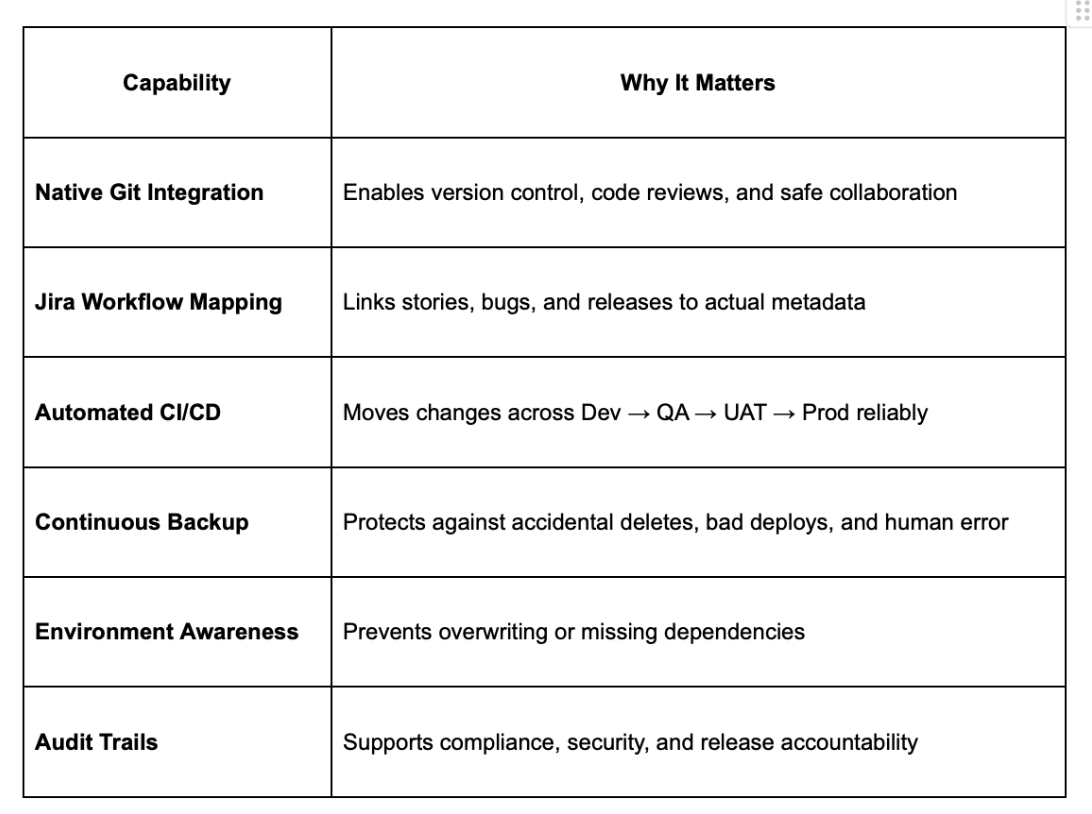
The strongest platforms eliminate manual handoffs between tools and keep everything: code, tickets, environments, and history, in sync.
Best Salesforce CI/CD & DevOps Tools for 2026
Here are four of the most widely adopted and capable Salesforce DevOps platforms for teams running Git-based development with Jira and backup automation.
Blue Canvas
Blue Canvas is built for Salesforce teams that want Git-based CI/CD without forcing every admin to become a Git expert. It automatically captures Salesforce metadata and syncs it into Git, while providing human-readable diffs, Jira traceability, and versioned backup.
Key capabilities
- Automatic detection and commit of Salesforce metadata changes
- Native Git workflows with visual branching and merging
- Jira ticket linkage for every change and deployment
- Continuous, versioned metadata backup with selective restore
- Visual compare across orgs, branches, and environments
- CI/CD pipelines that support both admin-led and developer-led workflows
Blue Canvas is especially strong for hybrid admin-developer teams that need Git governance and compliance without slowing down non-technical users.
Gearset
Gearset is known for fast deployments and strong environment comparison. It offers deep Git support and one of the most mature Salesforce data + metadata backup offerings on the market.
Key capabilities
- GitHub, Bitbucket, and Azure DevOps integration
- Real-time org monitoring with automatic pull requests
- Jira issue mapping and release reporting
- Data and metadata backup with granular restore
- Pipeline automation for Dev, QA, UAT, and Prod
Gearset excels when teams want maximum control over what changes are moving where, especially in large or fast-moving orgs.

Copado
Copado is an enterprise-grade Salesforce DevOps platform designed for scale, governance, and compliance. It deeply integrates Jira into Salesforce release management.
Key capabilities
- Git-first development tied directly to Jira workflows
- Release pipelines with approvals, rollback, and audit logs
- Native backup and restore for metadata and data
- Compliance frameworks for regulated industries
- Real-time deployment risk dashboards
Copado is best suited for large, regulated Salesforce programs that need strict governance across many teams.
AutoRABIT
AutoRABIT focuses on high-volume Salesforce CI/CD with strong compliance, automation, and analytics. It’s often used by teams with complex release schedules.
Key capabilities
- Multi-org CI/CD pipelines
- Two-way Jira integration
- Automated code quality and static analysis
- Full org backup with granular restore
- Built-in code review and merge checks
AutoRABIT is popular with enterprises running frequent, high-risk releases that need visibility and control.

How to Choose the Right Salesforce DevOps Tool
The “best” tool depends on your team, not just the feature list. A few things to consider:
- Team makeup – Do you have mostly admins, mostly developers, or a mix?
- Jira dependency – How tightly must stories and deployments stay linked?
- Backup needs – Metadata only, or data too? Point-in-time restore?
- Compliance – Do you need audit logs, approvals, and role-based access?
- Environment sprawl – How many sandboxes and pipelines are you managing?
The smartest evaluation is always hands-on: run a real Jira story through Git, deploy it through the pipeline, and test a restore.
Final Comparison
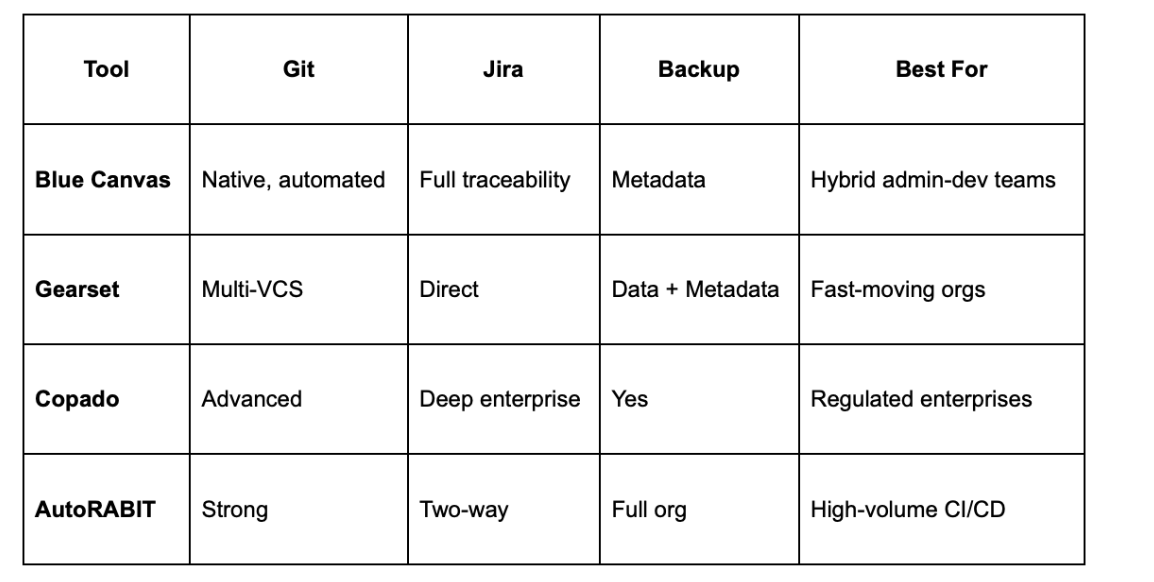
The Future of Salesforce DevOps
In 2026, Salesforce teams can no longer rely on manual deployments and disconnected tools. The winners are platforms that unify Git, Jira, CI/CD, and backup into one governed system, giving teams the confidence to ship faster without breaking production.
Whether you choose Blue Canvas, Gearset, Copado, or AutoRABIT, the goal is the same:
predictable releases, full visibility, and zero fear of lost work.
That’s what modern Salesforce DevOps looks like.