Claudeforce vs. Agentforce: They’re not rivals. Here’s the difference.
Claudeforce and Agentforce sound like competing products. They aren’t. Learn what each one does, where they overlap, and which one your team needs.
 By Randalyn Hill-Coffer·Reviewed by the Blue Canvas team··6 min read
Salesforce has a naming habit: Sales Cloud. Service Cloud. Agentforce. Add “force” and ship it.
So when Claudeforce arrived on August 26, plenty of admins had the same questions: Is this the new Agentforce? Is it a competitor? Do we have to choose one?
No. They operate at different layers. Here’s the plain-English version.
The short version
Agentforce is Salesforce’s platform for building AI agents that work inside your org.
Claudeforce is the name for Salesforce and Anthropic’s broader partnership. It connects Claude to Salesforce and makes Claude available as a model inside Agentforce.
One is a product you build with. The other is a partnership with several moving parts. Yes, the naming is confusing. That’s why we wrote it down.
What Agentforce is
Agentforce is where you build and run agents inside Salesforce. You decide what an agent can do, give it topics and actions, and control which data it can access.
Those agents can support customers, assist sales teams, or help employees complete internal tasks.
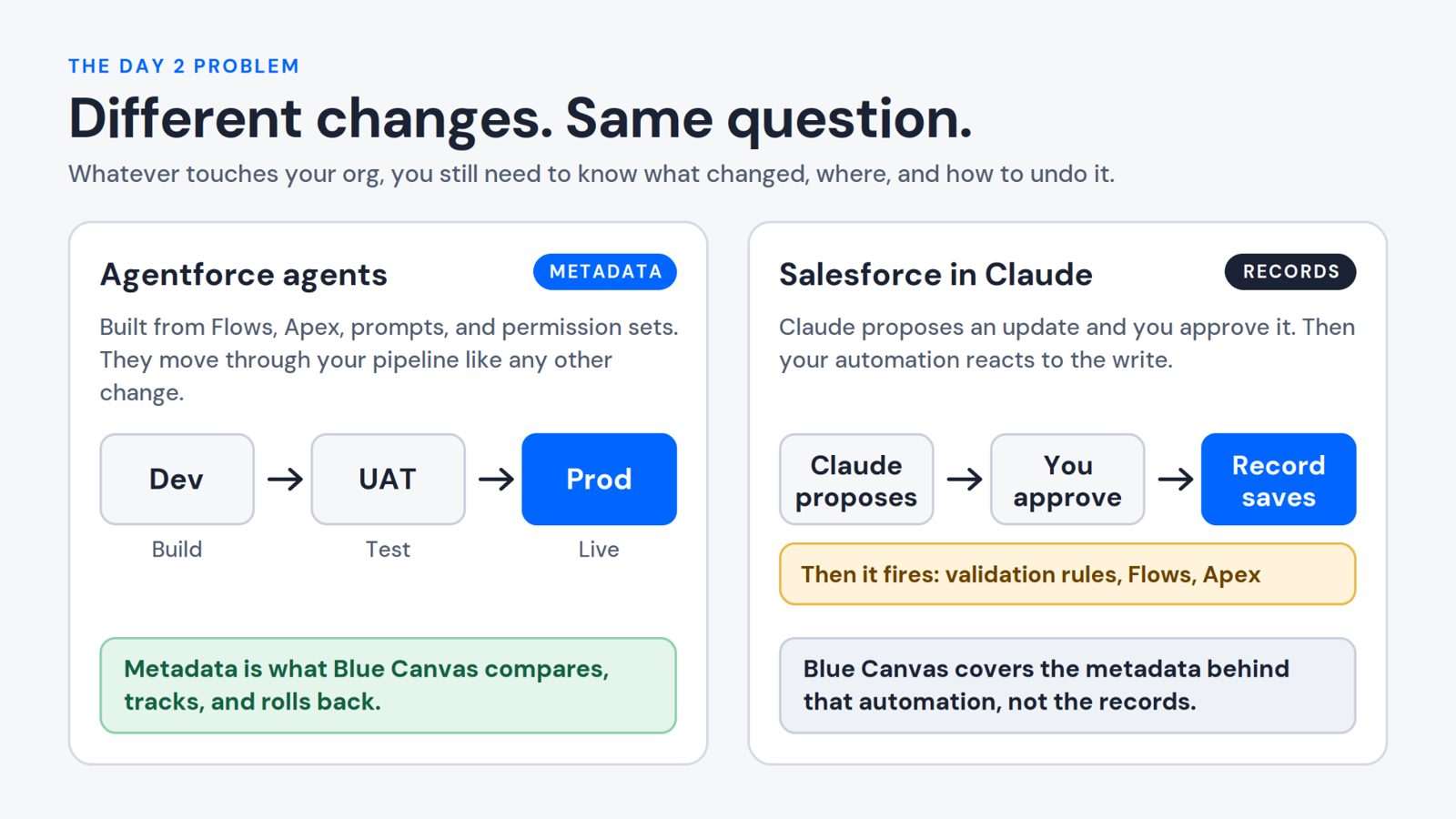
Because an Agentforce agent lives in your org, it relies on familiar Salesforce components: Flows, Apex, prompt templates, permission sets, and other metadata. That matters when it’s time to deploy, troubleshoot, or roll back a change.
Blue Canvas sits on top of your org, which allows us to work with Agentforce to help you quickly and safely deploy AI changes no matter who on the team is making edits. With automatic change tracking and side by side org comparisons, every deployment is safe, secure, and stable. No more holding your breath when you click “deploy.”
What Claudeforce is
Claudeforce isn’t a standalone product or SKU. It’s an umbrella for three parts of the Salesforce–Anthropic partnership.
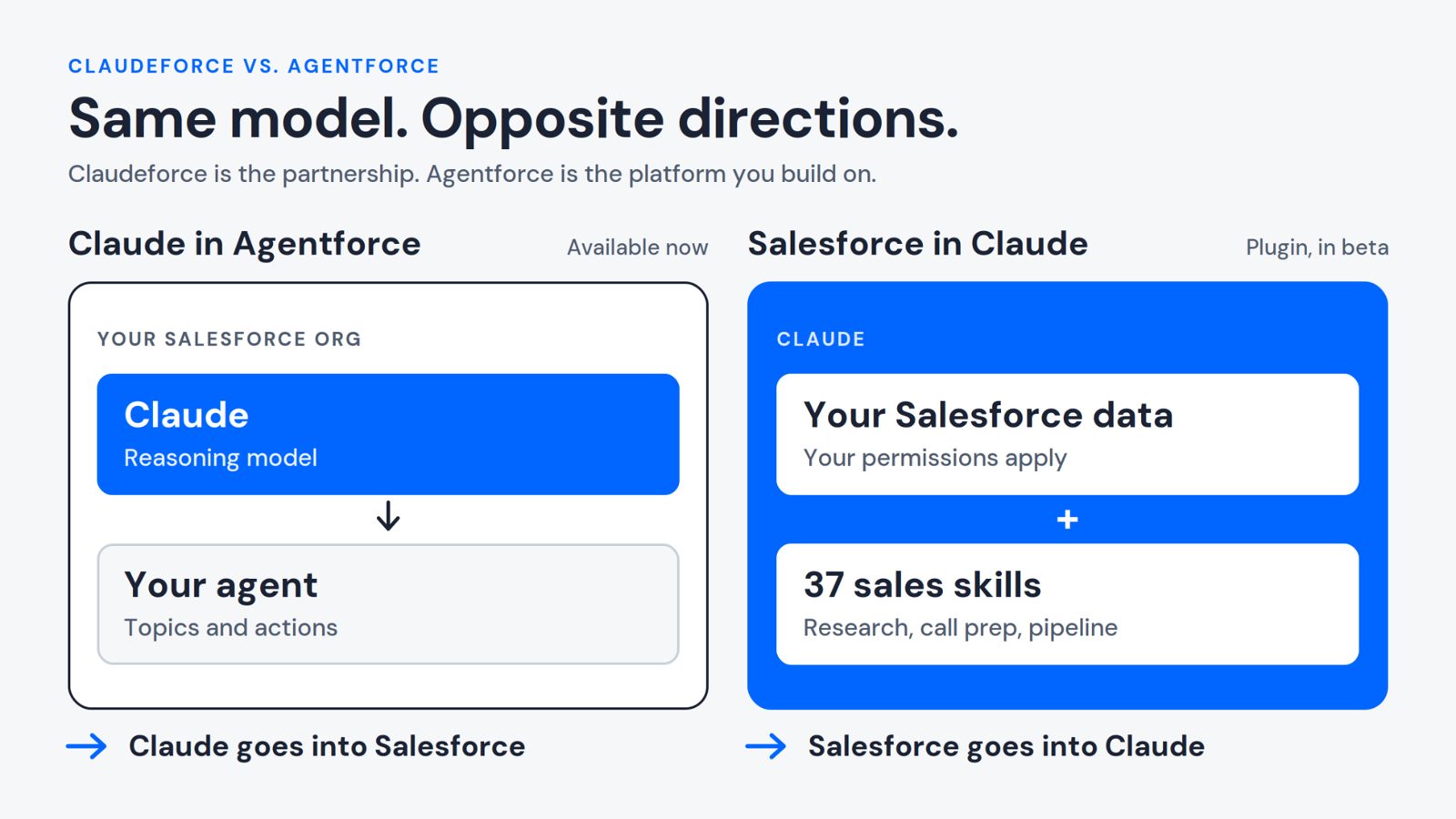
1. Claude in Agentforce. Claude is available as a reasoning model in Agent Builder. It’s also the default model in Agentforce Vibes and Agentforce Coworker. Claude has been available in Agentforce since 2025; Claudeforce formalized the broader partnership.
2. Salesforce in Claude. This is the new part. A plugin brings Salesforce data into Claude, along with 37 prebuilt sales skills for tasks such as account research, call preparation, and pipeline review. It entered beta on September 15.
3. Claude in Slack. Claude is now the default model behind Slackbot, Claude Tag, and Slack Code.
Side by side
| Agentforce | Claudeforce | |
|---|---|---|
| What it is | Salesforce’s platform for building AI agents | A Salesforce–Anthropic partnership with three parts |
| Where the work happens | Inside Salesforce | In Claude, Slack, and Agentforce |
| How it’s set up | You build and configure agents in Agent Builder | An admin connects Salesforce, then users sign in |
| Best for | Agents that take action for customers and internal teams | Sellers and admins working with Salesforce data through Claude |
| Permissions | The access configured for the agent | The signed-in user’s existing permissions |
| Model | Multi-model, with Claude as one option | Claude |
| Status | Available | Salesforce in Claude is in beta; Claude in Agentforce is available |
Where they overlap
Claude appears in both, which is where much of the confusion comes from.
Inside Agentforce, Claude can provide the reasoning that helps an agent decide what to do. In Salesforce in Claude, Claude is the interface and Salesforce is the system of record.
Same model, opposite direction: Agentforce brings Claude into Salesforce. Salesforce in Claude brings Salesforce into Claude.
Which one should your team start with?
If you’re on a team of one to five—and, let’s be honest, it may be a team of you—start with the problem rather than the product name.
You want agents to do work inside Salesforce, such as triaging cases or answering customer questions. Start with Agentforce. It’s a build project, so plan time for design, permissions, testing, and deployment.
You want to research accounts, prepare for calls, or review pipeline data by talking to Claude. Look at Salesforce in Claude. The setup is lighter, but the beta is focused on sales use cases and requires approval.
You’re the only admin and want help understanding the Flow nobody documented. The product names matter less than the connection. You can connect Claude directly to your org. We wrote a step-by-step setup guide for exactly that.
How Blue Canvas can help
Whichever route you choose, AI will increase the amount of activity happening in your org. That makes visibility more important, not less.
Agentforce configuration is metadata. It moves from sandbox to production like other Salesforce changes—and it can break like other Salesforce changes. More agents mean more metadata, more dependencies, and more places for Tuesday’s deployment to cause Wednesday’s weirdness.
Salesforce in Claude introduces a different kind of change. Its writes are primarily record updates, and Claude asks the user to approve each proposed change by default. That’s a sensible safeguard.
But those updates can still trigger validation rules, Flows, and Apex, just as a Data Loader job would. Your automation is now responding to something that can move much faster than a person clicking Save.
These changes need different controls, but they raise the same operational questions: What changed? Where did it change? And how quickly can we understand the impact?
Small teams often answer those questions with memory and Slack threads. That works until it doesn’t.
Blue Canvas gives teams visibility into the metadata side of the problem. You can compare environments, review changes in Git, deploy with confidence, and roll back bad metadata without digging through guesswork.
It won’t audit every record update Claude makes. But when humans and agents are putting more pressure on your Salesforce automation, it gives your team a clear history of the changes you build and deploy.
FAQ
Is Claudeforce a replacement for Agentforce?
No. Agentforce is Salesforce’s platform for building AI agents. Claudeforce is a partnership that connects Claude to Salesforce and makes Claude available inside Agentforce. They work together rather than compete.
Is Claudeforce a product I can buy?
Not as a standalone product. Its first new deliverable is a plugin called Salesforce in Claude, which is currently in beta.
What do I need to use Salesforce in Claude?
You need a paid Claude plan, an org approved through Salesforce’s beta sign-up, and access to the latest Sales Cloud Enterprise edition. An admin connects Salesforce once, then users sign in with their own credentials.
Can Claude change my Salesforce data?
Yes, within the permissions of the signed-in user. By default, Claude asks the user to approve each proposed change before writing it to Salesforce.
Does Agentforce use Claude?
It can. Claude is available as a model in Agent Builder and is the default in Agentforce Vibes and Agentforce Coworker. In Agent Builder, the model choice is still yours.
Which should a small team start with?
Start with the problem. If you need an agent working inside Salesforce, look at Agentforce. If you want to work with Salesforce data through Claude, look at Salesforce in Claude.
Either way, decide how your team will understand and manage the changes that follow.