Dreamforce 2026 Keynote: 7 Salesforce Announcements You Need to Know
Over two hours, Salesforce tried to show what that future actually looks like. Here are seven of the biggest announcements and moments from the Dreamforce 2026 keynote.
 By Kenji Sano·Reviewed by the Blue Canvas team··8 min read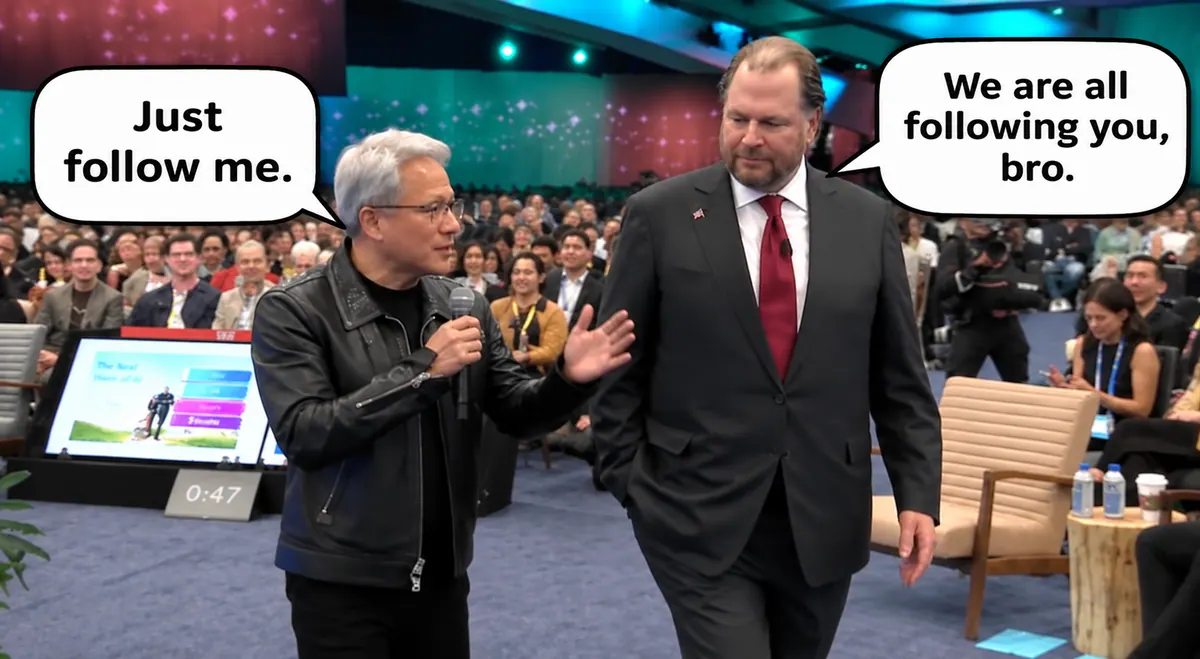
1. Salesforce Introduces AIforce
The biggest announcement of Dreamforce 2026 was AIforce, which Salesforce describes as a live interface layer connecting the Salesforce platform to wherever people and AI agents work.
The idea is that the valuable parts of Salesforce don’t necessarily need to stay inside the traditional Salesforce interface. AIforce can make Salesforce data, workflows, business logic, permissions, security, and governance available to other AI interfaces while continuing to apply the controls companies already have in Salesforce.
Instead of opening Salesforce, finding the right record, navigating through several screens, and completing a workflow, a user could increasingly ask an AI interface for what they need and let Salesforce provide the context and actions behind the scenes.
Salesforce calls this an “interface revolution.” AIforce launches with Claudeforce, Slackforce, and Agentforce Coworker, giving us an early look at what the company means by bringing Salesforce to wherever people and agents work.
That idea became the thread connecting almost everything else shown during the keynote.
2. NVIDIA and Salesforce Introduce Koa
Salesforce had been teasing its NVIDIA partnership before Dreamforce with a simple line: “.@nvidia x Salesforce have been cooking.”
Then NVIDIA founder and CEO Jensen Huang walked onto the Dreamforce stage alongside Marc Benioff.
The two discussed the opportunity ahead for enterprise AI, but one of the best moments happened when Huang left the stage and started walking through the audience with Benioff following behind.
“We’re all following you, bro,” Benioff joked.
There was also a serious message behind Huang’s appearance. He argued that AI is becoming a new infrastructure layer capable of changing virtually every industry and encouraged businesses to engage with the technology rather than sit on the sidelines.
The partnership also produced one of Salesforce’s most important technical announcements: Koa, Salesforce’s first CRM reasoning model for Agentforce.
Built on NVIDIA Nemotron 3 Super, Koa is designed specifically for complex, multi-step CRM work. Instead of trying to compete as another general-purpose AI model, Koa focuses on tasks such as updating opportunities, routing cases, scheduling follow-ups, selecting the correct Salesforce actions, and coordinating business processes.
Salesforce says Koa was post-trained using a proprietary synthetic dataset modeled on 27 years of CRM deployments, with no customer data used for training. According to Salesforce, Koa matches or exceeds leading models on CRM actions in its benchmark while producing three times fewer errors.
It’s an interesting direction for Agentforce. Salesforce isn’t betting entirely on increasingly powerful general-purpose AI models. It’s also betting that models specifically trained to understand how CRM workflows operate can perform enterprise tasks more reliably.
3. Slackforce Makes Slack an Interface for Salesforce
Another major part of Dreamforce 2026 was Slackforce, which brings Salesforce data, agents, workflows, and collaboration together inside Slack.
Salesforce’s pitch was simple: “Slack is where AI works.”
The company demonstrated a future where Slack becomes more than the place employees discuss work. It becomes an interface where people and AI agents can actually execute that work together.
Instead of constantly switching between Salesforce, Slack, dashboards, development tools, and AI assistants, Salesforce wants users to interact with many of those capabilities from one collaborative environment. Slackforce brings together technologies including Slackbot, Salesforce CRM capabilities, and Slack Code, while new Slack surfaces can dynamically present information and actions around the task at hand.
This may ultimately be more important than any individual Agentforce feature announced at Dreamforce. Salesforce isn’t simply putting another AI assistant inside the existing Salesforce UI. It’s experimenting with the idea that AI itself can become the interface to Salesforce.
4. Salesforce Introduces New AIforce Pricing
One of the most important announcements for existing Salesforce customers wasn’t another AI demo. It was how Salesforce plans to package and price all of this.
About 45 minutes into the keynote, Benioff presented a new edition structure built around AIforce, with three tiers: Core at $195 per user per month, Advanced at $395, and AIforce Max+ at $550.
Core includes foundational Sales, Service, and Industry applications alongside Agentforce and 500,000 Flex Credits. Advanced adds capabilities including Casey the Help Agent, Backup & Recover, Security Center, and 1 million Flex Credits. AIforce Max+ goes further with Salesforce in Claude, the upcoming Agentforce Coworker, Sales Planning, Workforce Management, and 2.75 million Flex Credits.
Salesforce also presented a free upgrade path into the new structure for customers already on Agentforce 1 Edition.
The pricing announcement matters because of what Salesforce is choosing to bundle together. AI isn’t being positioned as a separate experiment or optional feature anymore. Agentforce, applications, security, collaboration, AI interfaces, and usage-based Flex Credits are increasingly being packaged as parts of the same Salesforce platform.
For customers, that means the shift toward AIforce isn’t just a product strategy. It’s becoming a pricing and packaging strategy too.
5. Claude Comes to Salesforce
One of the most interesting demonstrations during the Dreamforce keynote involved Salesforce’s expanded partnership with Anthropic and Claude.
Salesforce demonstrated Claude working directly with Salesforce context, answering questions about business data and creating an interface around the work being performed.
Rather than navigating through a collection of predefined Salesforce screens, a user can increasingly describe what they need and let the AI create the experience around the task. Salesforce’s permissions, business logic, workflows, and governance still sit underneath that interaction.
That’s what makes the partnership more interesting than simply saying “Claude connects to Salesforce.” The interface changes.
Salesforce becomes the trusted business layer behind the experience, while Claude becomes one of the ways a user interacts with it.
For Salesforce customers, this could represent a major shift in how people use CRM. A salesperson, service representative, or executive may not always need to know where a particular field, report, or workflow lives inside Salesforce. They can increasingly describe what they want to accomplish and let the AI work with Salesforce on their behalf.
That’s also one of the clearest demonstrations of the broader AIforce strategy: Salesforce wants the value of its platform to be available even when the user isn’t actually looking at Salesforce.
6. Siemens Shows What an Agentic Enterprise Looks Like
The keynote then moved from product announcements to a large enterprise example.
Siemens President and CEO Roland Busch joined Benioff on stage to discuss how Siemens is using Agentforce across its organization. One example involved an AI SDR helping turn inbound website interest into qualified pipeline, while another demonstrated Agentforce Supply Chain coordinating work between agents and employees.
Salesforce and Siemens also announced an expanded partnership connecting Agentforce with Siemens’ Teamcenter Service Lifecycle Management, with the goal of bringing Salesforce AI capabilities into industrial sales, service, and lifecycle workflows.
The Siemens example matters because “agentic enterprise” can otherwise be difficult to visualize. Showing agents participating in actual sales, service, supply-chain, and industrial processes makes the idea much more concrete.
Instead of AI simply answering questions, Salesforce wants agents to participate in workflows alongside employees and other systems. For large Salesforce customers, that may be one of the more important changes to watch over the next few years.
7. Fin Joins a Growing Salesforce AI Ecosystem
Dreamforce 2026 also welcomed Fin AI to the Salesforce ecosystem for its first Dreamforce.
It wasn’t the biggest announcement of the keynote, but it was another indication of how broad Salesforce’s AI strategy is becoming. Fin joins an ecosystem that now prominently includes companies such as NVIDIA and Anthropic alongside Salesforce’s own Agentforce technology.
Across the keynote, the pattern became increasingly clear. NVIDIA provides technology behind Salesforce’s new Koa reasoning model. Anthropic brings Salesforce into Claude. Siemens demonstrates how agents can operate across complex enterprise workflows. Slack provides another interface for Salesforce data and agents. And Fin adds another AI player to the expanding ecosystem around the platform.
Salesforce isn’t trying to build every component of the AI stack itself. Instead, AIforce increasingly looks like the layer Salesforce wants to use to connect different AI models, agents, applications, interfaces, and enterprise systems with the business context already stored inside Salesforce.
That approach makes sense for enterprise customers because most companies probably won’t use one AI model, one agent, or one interface. They’ll use many of them.
Salesforce wants to make sure its data, permissions, workflows, and business logic remain underneath those experiences.
Other Dreamforce 2026 Keynote Highlights
Not everything at Dreamforce was about AI.
Salesforce also celebrated 20 years of the Trailblazer Community, including honoring longtime community member Steve Molis with the Golden Hoodie. Salesforce says Trailblazers have now built 12 million apps, drive 9.6 billion API calls every day, and have earned more than 151 million Trailhead badges.
The company also highlighted 27 years of its 1-1-1 philanthropy model, the practice of committing 1% of equity, 1% of product, and 1% of employee time to communities. Salesforce highlighted nearly $1 billion in grants and millions of volunteer hours generated through the model.
These moments were a reminder that despite how dramatically the technology discussed at Dreamforce has changed, Salesforce still wants the community built around its platform to remain central to its identity.
What Dreamforce 2026 Tells Us About the Future of Salesforce
Toward the end of the keynote, Benioff summarized the strategy: “When you put all those things together, you get AIforce.”
That’s probably the simplest way to understand Dreamforce 2026.
Koa provides specialized CRM reasoning. Agentforce provides agents. Salesforce provides the data, metadata, permissions, workflows, security, and business logic. NVIDIA provides some of the underlying AI technology. Claude provides another interface into Salesforce. Slack provides a collaborative environment where people and agents can work together. And partners like Fin are expanding the ecosystem around it.
AIforce is the layer Salesforce wants connecting all those pieces.
For years, Salesforce’s interface was the CRM itself. Dreamforce 2026 suggested something different: Salesforce increasingly wants its platform to sit behind the scenes while AI becomes the interface through which people interact with it.
If Salesforce can make that model reliable enough for enterprise use, that may ultimately be the most important announcement to come out of Dreamforce 2026.