Top 19 Academic Operations Tools for Salesforce-Run Higher Ed Campuses in 2027
Compare 19 academic operations and adjacent higher ed tools for Salesforce-run campuses in 2027. See what runs on Salesforce, what connects through your SIS, and where you may need an integration.
 By Randalyn Hill-Coffer·Reviewed by the Blue Canvas team··8 min read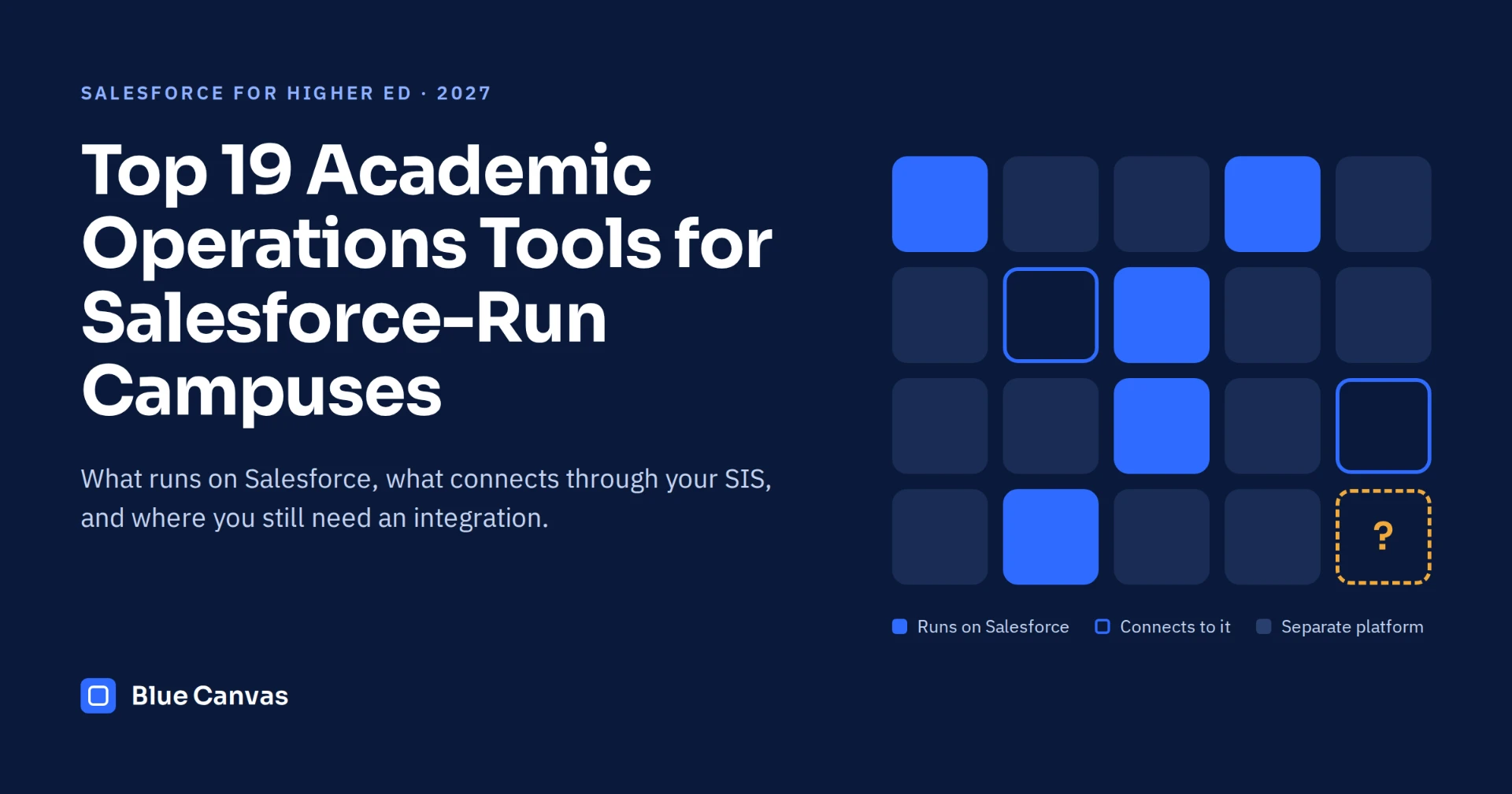
Search “academic operations for Salesforce” and you’ll find two kinds of answers mixed together. Some tools run on Salesforce. Others manage curriculum, schedules, catalogs, or degree plans in separate systems that a Salesforce campus may also use. A few handle adjacent jobs, such as admissions, learning, outreach, and credentials.
All 19 belong in a campus technology conversation, but they don’t share one integration path. For each, ask where the data lives, how it reaches Salesforce, and who owns the connection. This is a practical shortlist, not a ranking based on a shared feature scorecard.
The problem nobody mentions in the sales demo
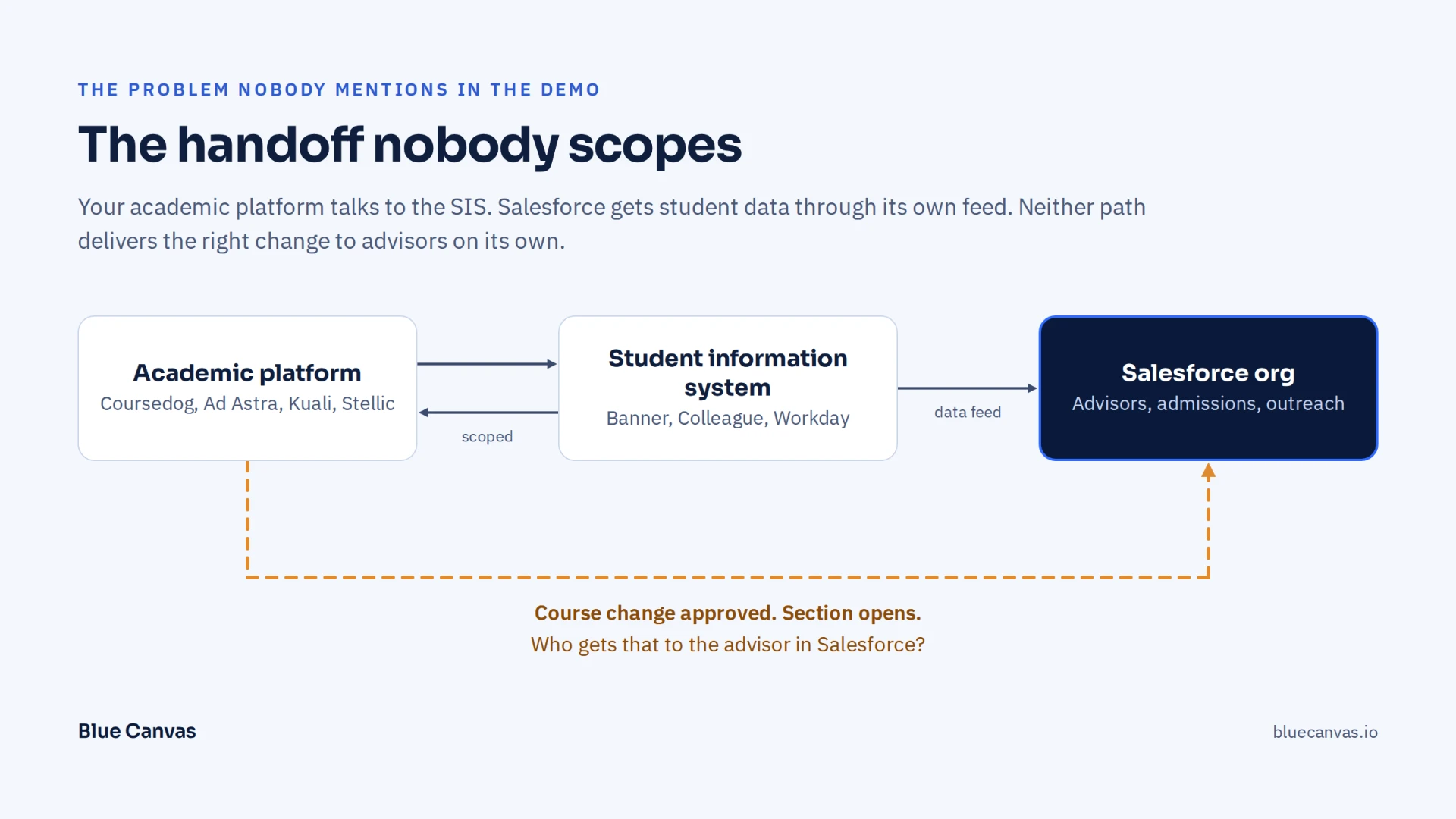
Here’s what can happen. An institution picks Coursedog or Ad Astra to modernize scheduling. Salesforce stays in place for admissions and advising. The rollout goes fine. Then an approved curriculum change needs to reach an advisor’s Salesforce view, or a section opening needs to trigger outreach. Nobody scoped that last step.
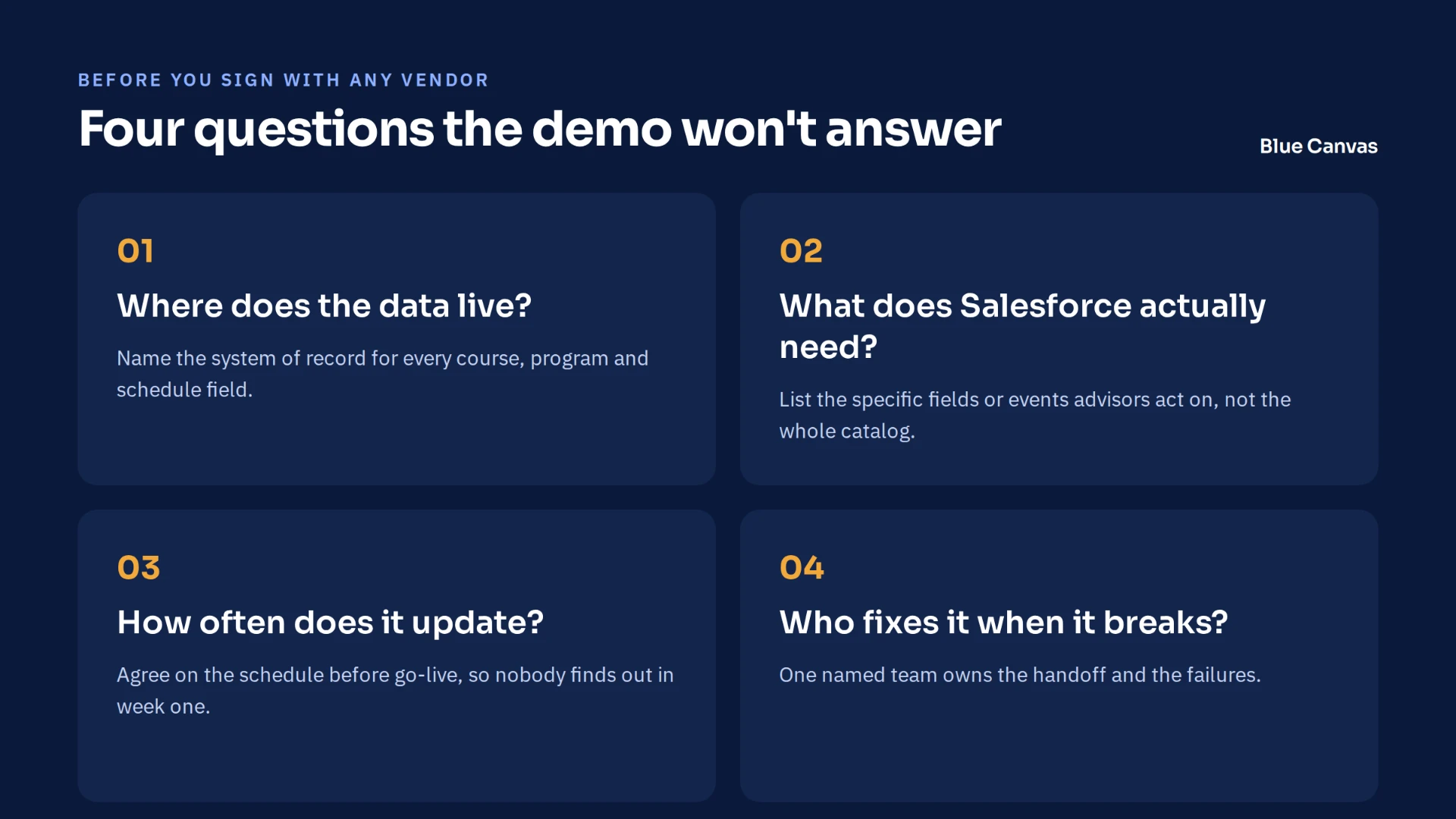
The academic platform may exchange data with the student information system (SIS), while Salesforce gets its student data through a different feed. Neither connection automatically gives advisors the right change at the right time. Before signing, identify the system of record, the fields or events Salesforce needs, the update schedule, and the team that fixes failures.
Curriculum, scheduling, and degree planning
1. Coursedog
Coursedog brings curriculum management, catalog publishing, course and event scheduling, faculty workload, and assessment into one academic operations platform. Its published integrations emphasize SIS connections, including Banner, Colleague, Workday Student, PeopleSoft, and Jenzabar, along with other campus systems.
Salesforce fit: Treat Coursedog-to-Salesforce as a separate requirement. Specify whether the data should pass through the SIS or another integration path, and confirm the method for your institution.
2. Ad Astra Information Systems
Ad Astra concentrates on course and event scheduling, room use, and planning around student demand. Its academic scheduling product describes bidirectional SIS integrations. That can help a registrar build a better schedule, but an advisor’s Salesforce alert still needs its own source and trigger.
Salesforce fit: Decide which changes matter in Salesforce, such as a required section opening or filling, and trace their path from Ad Astra through campus systems.
3. Kuali
Kuali Academic Operations covers curriculum, catalog, syllabus, and advising. Kuali describes SIS and API integration options, and Ad Astra documents an integration with Kuali for institutions using the two together.
Salesforce fit: Confirm where an approved course or program change becomes authoritative, then map only the changes that Salesforce users need. The Kuali and Ad Astra connection does not itself specify a Salesforce workflow.
4. Stellic
Stellic supports degree audit and multiyear degree planning, with SIS integration for academic records and registration. A degree progress signal can be valuable in Salesforce advising, provided the institution defines which change warrants action and who can see it.
Salesforce fit: Design the SIS or other governed data path for the particular degree progress signals advisors need; do not assume the full audit belongs in CRM.
Tools that run on or connect directly with Salesforce
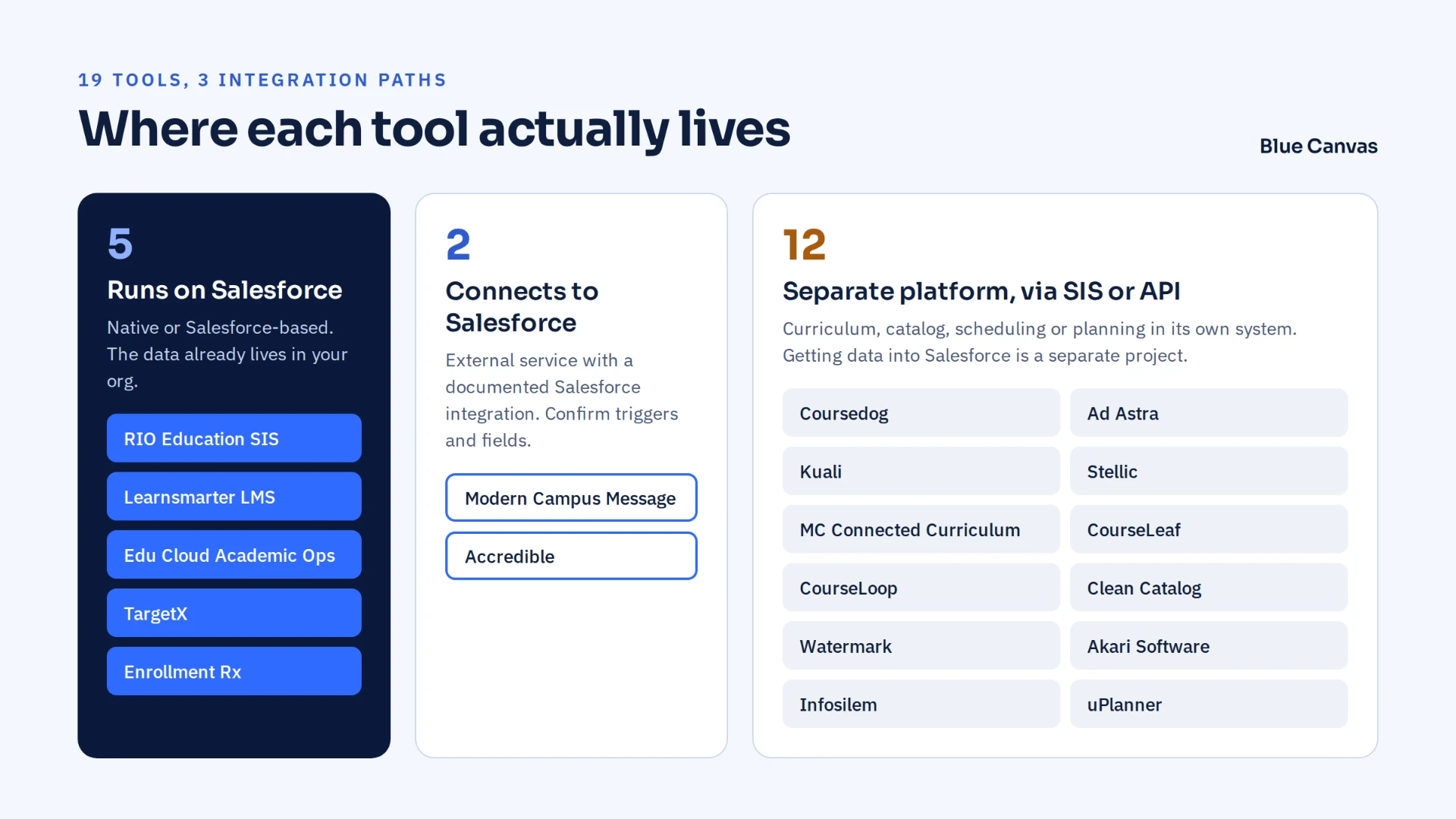
These products do different jobs. A native Salesforce SIS and an external credential platform with a Salesforce integration should not be treated as the same kind of deployment.
5. RIO Education Student Information System
RIO Education is an SIS built natively on Salesforce. It manages core student information and academic processes inside the platform; its feature documentation describes support for both Education Data Architecture and Education Cloud.
Salesforce fit: Native. If you plan to use Salesforce as the SIS, compare RIO’s specific records and processes with your current system of record before planning a migration.
6. Learnsmarter LMS
Learnsmarter is a Salesforce-native LMS for content, programs, assessments, and live training. It is most relevant when learning or continuing education activities need to stay close to CRM records. It serves a different purpose from a registrar’s curriculum and scheduling platform.
Salesforce fit: Native LMS. Check how enrollments and completions relate to your SIS and to the Salesforce learner record you already maintain.
7. Salesforce Education Cloud Academic Operations
Salesforce’s Academic Operations app supports courses, programs, program plans, prerequisites, learning outcomes, and academic schedules within Education Cloud. Evaluate the available capabilities against your institution’s actual catalog, governance, registration, and SIS requirements rather than assuming a one-for-one replacement for a specialized vendor.
Salesforce fit: Native Salesforce capability. Scope the licensing, data model, and migration work for your use case.
8. Modern Campus Message
Modern Campus Message for Salesforce lets staff see conversations and sync selected fields with the Message platform. It can support registration reminders and advising follow-ups. This is a messaging integration, not Modern Campus’s curriculum or catalog system.
Salesforce fit: A documented Salesforce integration with an external messaging service. Confirm the data shared, message triggers, and ownership of consent and contact fields.
9. Accredible
Accredible issues digital badges and certificates and offers a Salesforce integration. It is relevant when a continuing education or microcredential program wants a verified credential tied to a completion event. Accredible itself remains a separate credentialing platform.
Salesforce fit: Salesforce-connected. Verify which Salesforce record triggers issuance and what credential status is written back.
10. TargetX
TargetX is a Salesforce-based recruitment and admissions suite for prospect engagement, applications, review, and enrollment workflows. It also documents SIS integrations. It belongs here because admissions teams may need accurate program and course information from the academic side, even though TargetX is not a curriculum management tool.
Salesforce fit: Built on Salesforce. Confirm how academic program changes enter the admissions workflow and how TargetX and the SIS exchange student data.
11. Enrollment Rx
Enrollment Rx offers Salesforce-native recruitment, admissions, and decision management tools, along with portals and workflow products. Its Integration Rx addresses data connections to other campus systems.
Salesforce fit: Built on Salesforce. Specify which program, course, and enrollment data admissions needs and how Integration Rx or another process will keep it current.
More academic operations platforms to evaluate
These products cover curriculum, catalog, scheduling, or planning in their own platforms. Their published SIS, API, and campus integrations vary. Ask each vendor about your exact Salesforce use case rather than treating any campus integration as a ready-made CRM connection.
12. Modern Campus Connected Curriculum
Modern Campus offers curriculum, catalog, and scheduling products, including tools historically known as Curriculog and Acalog. That is a different product family from Message above. Modern Campus Catalog publishes course and program information across student-facing experiences.
Salesforce fit: Product-specific. Map how an approved curriculum change reaches the SIS and which version of that information Salesforce should show. The Message integration does not establish a Salesforce connector for Connected Curriculum.
13. CourseLeaf
CourseLeaf links curriculum proposals, catalogs, schedules, syllabi, student planning, and registration. It documents integrations with Banner, PeopleSoft, Colleague, Workday Student, and other campus systems.
Salesforce fit: Scope a separate feed or API workflow if Salesforce users need approved CourseLeaf-managed course, program, or schedule information.
14. CourseLoop
CourseLoop supports curriculum development, governance, catalog publication, and student planning. Its developer portal provides API schemas for integration with university systems.
Salesforce fit: Ask which API or export exposes the approved version of academic data, then define the update path into Salesforce.
15. Clean Catalog
Clean Catalog provides catalog, curriculum, and syllabus management. It describes API and SIS integration options that can move academic content between systems.
Salesforce fit: Confirm whether your use case calls for an SIS exchange, an API connection, or both, and which system owns each course or program field.
16. Watermark
Watermark Curriculum Strategy joins curriculum workflows and catalog management. Watermark describes syncing approved course changes back to the SIS and offers Curriculum Strategy APIs for data access.
Salesforce fit: Trace the approved change through the SIS or API before designing any Salesforce view or automation. Confirm the fields and direction of exchange for your deployment.
17. Akari Software
Akari Software centers on curriculum design, governance, mapping, and review. It describes a REST API suite and connectors for sharing curriculum data with downstream systems.
Salesforce fit: Determine which approved curriculum version staff need in Salesforce and confirm the API and connector scope with Akari.
18. Infosilem
Infosilem offers academic, exam, and campus scheduling tools. Its FAQ discusses SIS integration and API access to scheduling data.
Salesforce fit: Name the scheduling event that should drive an advisor or outreach action, then scope its path through the SIS or another integration.
19. uPlanner
uPlanner spans academic demand planning, scheduling, curriculum quality, and student success. Institutions may use its planning outputs to align course demand with staff and space.
Salesforce fit: Confirm the available integration method and map only planning or student success signals that have a clear CRM use.
What actually determines whether any of this works
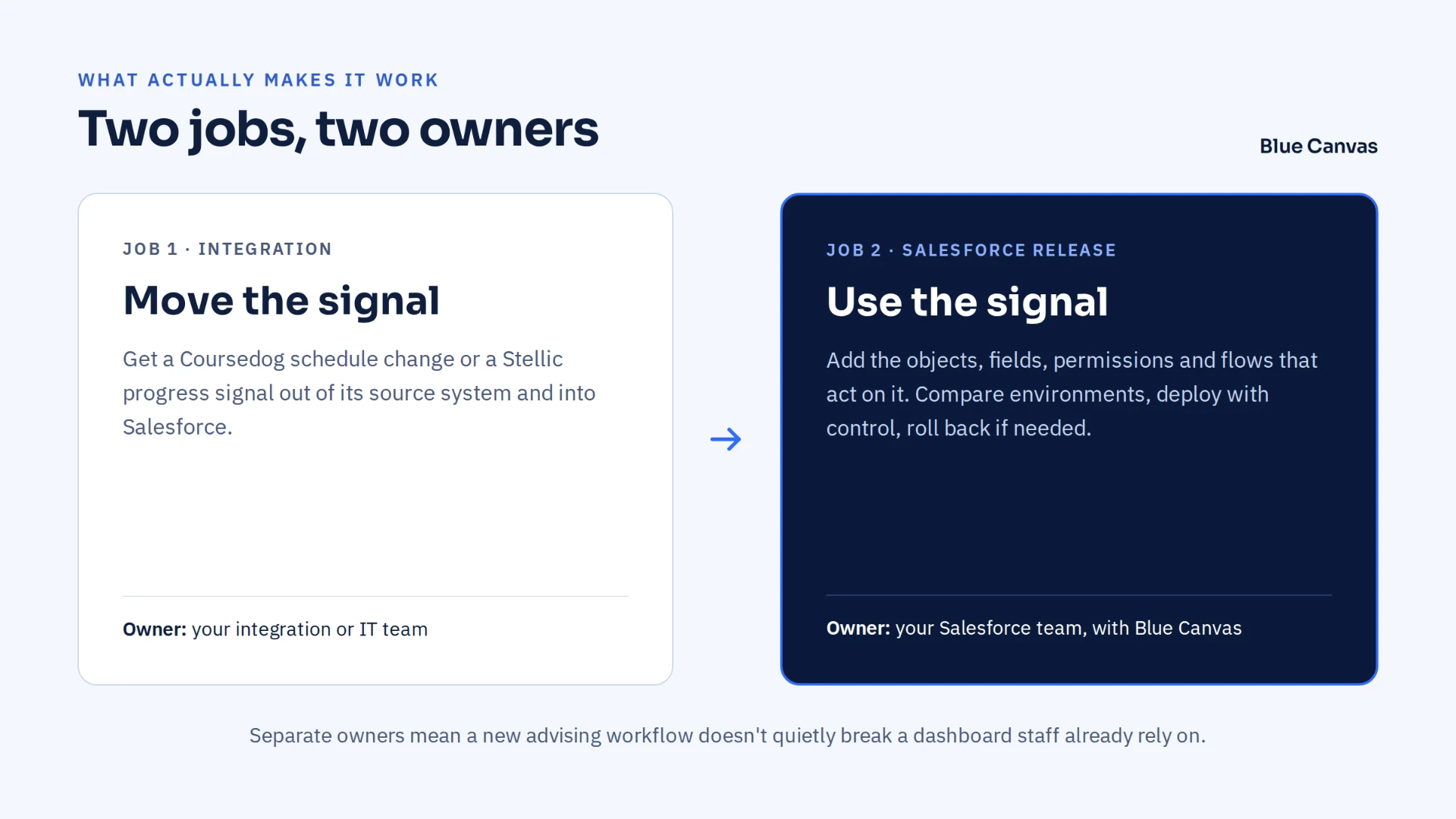
Whichever combination you choose, the data connection and the Salesforce changes around it need separate owners. Moving a Coursedog schedule or Stellic progress signal into Salesforce is an integration job. Adding objects, fields, permissions, and flows to use that signal is a Salesforce release job.
That’s where a tool like Blue Canvas fits: helping teams see what changed between Salesforce environments and move those changes into production with more control. It doesn’t create the SIS connection. It helps teams manage the Salesforce changes that depend on one, so a new advising workflow doesn’t quietly break a dashboard staff already use.
For a single org or a statewide multi-org setup, the same questions apply: What is the source of truth? Which team owns the handoff? How will you test the next change? Those answers determine whether the tools above become a dependable campus stack or another set of spreadsheets to reconcile.
FAQ
Does Coursedog integrate with Salesforce?
Coursedog publicly documents extensive SIS and other campus integrations. If you need Coursedog-managed data in Salesforce, confirm the specific route with the vendor and your IT team; an SIS integration alone does not put that data into a Salesforce record.
Which entries are built on Salesforce?
RIO Education, Learnsmarter, TargetX, and Enrollment Rx describe Salesforce-native or Salesforce-based products. Salesforce Education Cloud Academic Operations is Salesforce’s own app. Modern Campus Message and Accredible offer Salesforce integrations, while their services also run outside the org.
Why are TargetX and Enrollment Rx on an academic operations list?
They manage recruitment and admissions, not curriculum or scheduling. They’re included because Salesforce admissions teams often need the program and course information maintained by academic operations tools.
Is Modern Campus Message the same as Modern Campus Connected Curriculum?
No. Message supports communications and has a documented Salesforce integration. Connected Curriculum addresses curriculum and catalog workflows; confirm its data path separately.
Can Salesforce replace a traditional SIS?
Some institutions evaluate Salesforce Education Cloud capabilities or a native SIS such as RIO for that role. The answer depends on the institution’s academic records, registration, finance, compliance, and integration requirements, so compare those workflows directly before deciding.
Related reading: Single-Org vs. Multi-Org Salesforce for Higher Ed