2025’s Top Salesforce Team Deployer Tools: A Comprehensive Comparison
Which Salesforce deployer is right for you? This article will help you decide!
 By Randalyn Hill-Coffer·Reviewed by the Blue Canvas team··Updated February 13, 2025·4 min read
Many organizations using Salesforce are also investing in building the end-all-be-all solution to their reporting needs; they are investing in Salesforce admins and developers to create the perfect system for their needs. Oftentimes, the expectation of the team responsible for building out new features in Salesforce is to complete the task without breaking the system. So, how does the DevOps team work together to create a seamless rollout?
The challenges often arise in the communication and technical capabilities of the Salesforce Admins and the Developers.
- Admins - Useful and necessary education team-wide on how to use the platform while managing users, automation, fields, and building out reporting in the system.
- Developers - Build out higher-end upgrades to the platform. These can include custom APIs, workflows, integrations, and more to make data management effective and seamless.
So, how do you ensure that a smooth roll out happens with multiple chefs in the kitchen?
That’s where team-oriented deployment tools come into play!
Tools like this make it possible to track version changes, upload files from a sandbox of your choosing, and understand where validation or merge fields are going wrong, and they often make organizing the mass amount of files and code easy for everyone involved.
Let’s compare our Team Deployment software with a few others to help you pick the best resource for your team in 2025. ⬇️

Key Features of BlueCanvas.io
Blue Canvas is our top pick for a Salesforce Team-Based Deployer! Why?
Well, Blue Canvas makes the process simple, with an easy integration process, you’re up and running in no time. (No really, with just a few clicks, your whole team can access Blue Canvas and get to work.)
From there, Blue Canvas makes the collaboration process between your Admins and Developers a breeze. Our software means no more bouncing between screens, and we even made it look like Salesforce, so it’s easy to feel right at home!
In addition to our simple integration and our user-friendly interface, we also make version tracking and revisions a breeze.
We’re best known for our:
- Git-Based Version Control: Think automated tracking of metadata changes.
- Continuous Integration & Deployment: No more lag time, get real-time deployment synchronization.
- Automatic Change Monitoring: Need to make some last-minute tweaks? We detect and push updates seamlessly.
- Rollback & History Tracking: No more wondering where you went wrong! Easy reversion to previous states to help with problem-solving.
- User-Friendly Interface & Collaboration: We’re designed for Salesforce admins and developers alike, with an intuitive user experience so everyone feels right at home.
Let’s get the other team deployers most similar to Blue Canvas.
Competitor Analysis: How Does BlueCanvas.io Compare?
1. Gearset
Gearset is one of the top team deployment softwares out there. They offer a lot of the same benefits we do, like version tracking, easy sandbox deployment, and more! However, they integrate with multiple control platforms, which makes the user interface a little more complicated and less intuitive.
This software is great for companies looking for advanced CI/CD configurations but with all those extra features, it can have a learning curve when you implement it.
- Pros:
- Easy-to-use UI with drag-and-drop deployments.
- CI/CD integration with GitHub, Bitbucket, and Azure.
- Sandbox seeding and data deployment capabilities.
- Cons:
- More expensive pricing for small teams.
- Can have a learning curve for advanced CI/CD configurations.
2. Copado
Copado offers one step more for some of the metadata tracking we offer, making it a great fit for teams who need to follow specific compliance standards or be prepared with tracking data for audits.
This software is filled with great resources for DevOps teams, but it’s got a complex integration set up and can be tricky to roll out.
- Pros:
- Enterprise-grade DevOps platform with ALM capabilities.
- Strong governance and compliance tracking.
- Automated testing and security features.
- Cons:
- Overkill for small-to-mid-sized teams.
- Higher cost and complexity compared to alternatives.
3. Flosum
Flosum is the only software on this list that is 100% native to Salesforce, making it the ideal choice for companies worried about data security and compliance. None of your data is leaving the native platform, keeping it safe and protected while you make updates as needed.
This software is a little more rigid in its use cases due to being entirely native to Salesforce, so while you’ll stay well within your compliance regulations, it’s not always effective for teams who like to think outside of the box and use other control platforms.
- Pros:
- 100% Salesforce-native solution with strong security controls.
- No need for external Git repositories.
- AI-powered recommendations for deployments.
- Cons:
- It can feel restrictive due to its native-only approach.
- Pricing can be high for small teams.
4. AutoRABIT
AutoRABIT is one of the top solutions for large teams who need to rely on automation to empower their deployments.They can integrate with multiple control platforms while maintaining high levels of security and compliance regulations.
Due to the multiple control integrations and the advanced security measures, a lot of people find the user interface to beless intuitive and tricky to learn. However, for large teams that need high-security compliance, it can be a great fit.
- Pros:
- Strong automation and backup capabilities.
- Supports large enterprise deployments.
- Robust compliance and security tools.
- Cons:
- UI is not as intuitive as competitors.
- Pricing is geared towards larger organizations.
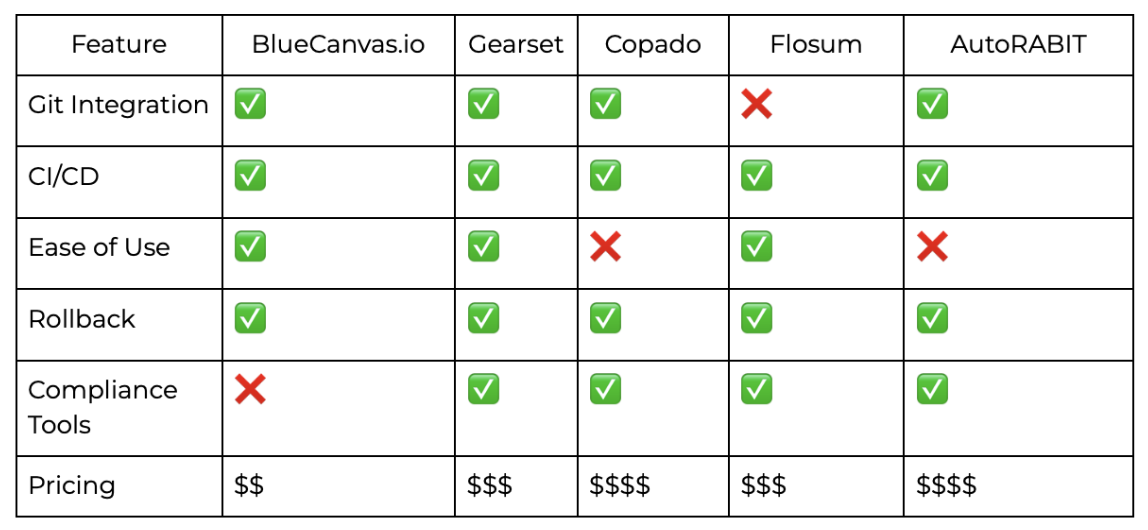
Feature Comparison Table
Looking for a quick side-by-side? Here’s how these softwares add up.
Who Should Use BlueCanvas.io?
Blue Canvas is best for teams needing a simple, Git-based deployment solution. We don’t integrate with other control platforms, making our interface much easier to use, but it limits your developers to Git-based updates.
We’re ideal for teams who want seamless change tracking without all the extra hassle of CI/CD configurations. While we do protect your data, we are not rated for highly compliant measures.
Blue Canvas is great for teams looking for a low-maintenance way to streamline their deployments and collaborate in one place.
Conclusion
While there are multiple great team-based deployer softwares, they are all built to function a bit differently.
If you’re looking for a deployer to merge multiple control platforms we recommend exploring Gearset, Copago, or AutoRABIT.
Teams looking for high-security compliance should explore Flosum or AutoRABIT.
However, if you’re looking for a quick and simple integration system for your team to effectively collaborate and deploy changes, Blue Canvas might be a great fit.
Want to learn more about Blue Canvas?