The DevOps Divide: How Low-Ops Unities Modern Teams
Let’s explore how modern teams can embrace a Low-Ops process to enhance team collaboration and increase feature development.
 By Randalyn Hill-Coffer·Reviewed by the Blue Canvas team··Updated January 26, 2026·4 min read
Salesforce development has reached a turning point in 2026. Teams are expected to build and ship code faster than ever. We have autonomous agents and complex Data Cloud integrations. We have flows that behave like enterprise software.
Metadata is the lifeblood of these systems. Yet, a massive wall still exists within most teams. On one side, we have developers. They live in the Command Line Interface (CLI). They love VS Code and complex Git commands.
On the other side, we have Salesforce Admins. They are masters of the platform UI. They build amazing things with clicks. Modern DevOps can leave them feeling left behind.
This is the DevOps Divide. It creates friction and slows down every release. Most tools try to solve this by making Admins act like engineers. This approach fails, because admins think and function differently. Teams don’t need more engineers.
They need a better collaboration system. Enter “Low-Ops.” Let’s explore how modern teams can embrace a Low-Ops process to enhance team collaboration and increase feature development.
What Exactly is Low-Ops?
Low Friction Operations: aka Low Cops is not about removing Git. It is about making Git invisible.
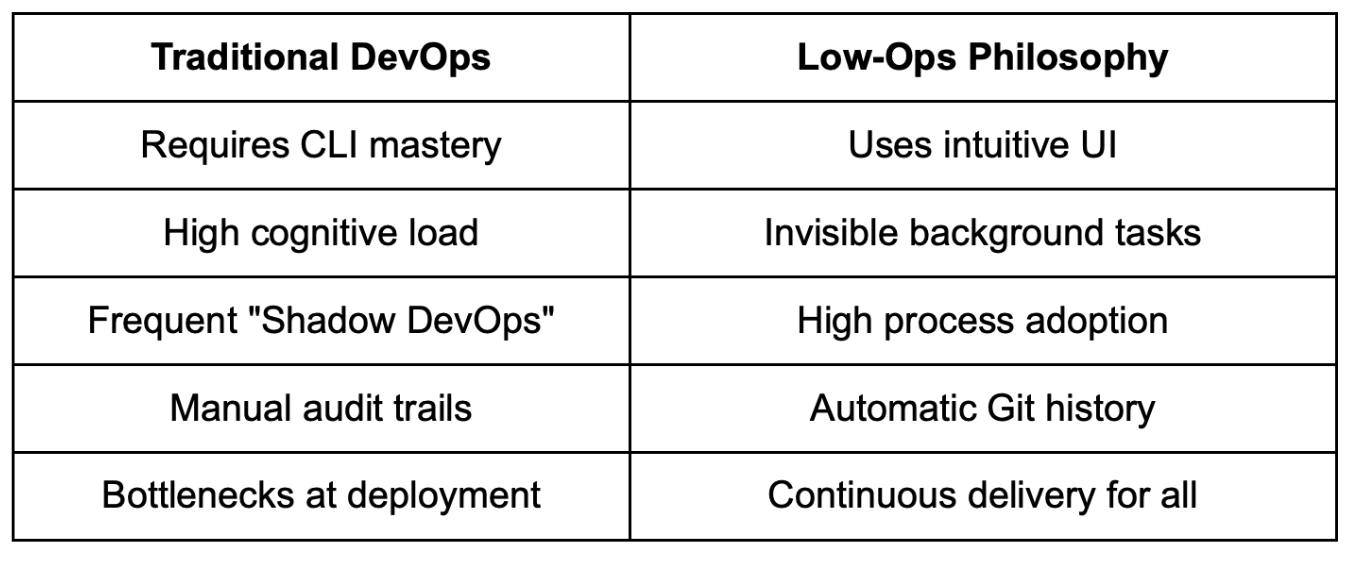
In a Low-Ops world, the process stays out of the way. Admins should not have to learn terminal commands. They should not have to worry about merge conflicts in a text editor.
Low-Ops provides the safety of Git without the technical complexity. Low-Ops technology, like Blue Canvas, captures every change automatically. It tracks who did what and when. It does this without requiring a degree or expertise in computer science.
Developers still get their high-code environment. Admins get to keep their declarative speed. The "Ops" part of the job happens quietly in the background. The mental load is removed from daily work. Low-Ops teams see increased creativity and collaboration along with a drastically decreased time to feature.

The Hidden Cost of "Tool Fatigue"
Many companies force every team member to use complex tools. In an attempt to standardize and simplify they have added a complexity tax. When an Admin struggles with a CLI, work stops. When a deployment fails due to a Git error, stress rises.
These minor inconveniences become your team's entry point for "Shadow DevOps."
Shadow DevOps refers to people bypassing the official process to make quick and “simple” manual changes due to frustration. These changes are often made directly to your production environment. No sandbox, no testing, no merge validation. They skip the process because the "official" way is too hard.
Low-Ops processes eliminate the need for Shadow DevOps. These tools and processes meet people where they already work. It values "Developer Joy" as a real business metric. Happy teams ship code 3x faster. Frustrated teams spend their Fridays fixing merge errors.
The Architecture of Trust
Low-Ops is built on a few core pillars. These pillars create a "System of Record" that everyone can trust. With the right tools, you can reliably set your team free in a Low-Ops environment and trust that your deployments will become stress free.
1. Automatic Versioning (or Change Tracking)
Every save in a sandbox should be a commit in Git. The user should not have to think about it. This creates a perfect audit trail. It happens without human effort. Automated Git sync means there’s no effort for the user to capture the data. If there is human effort required it often means that the system will fail due to human error. Automatic versioning removes the human effort AND the error from your critical processes.
2. Guardrails, Not Gates
DevOps should not be a gatekeeper. It should be a guardrail. A Low-Ops tool checks for errors before they reach production. It warns the user about dependencies and it does so in plain English.
The simpler it is to use and understand, the more likely it is your team will have success with it. No need to involve developers in simple updates, and no need for developers to loathe your admins. With the right role based guardrails your team can (and will) work like a well oiled machine.
3. One-Click Rollbacks
Mistakes will always happen. In the old world, a bad deployment meant a long weekend of fixes. In a Low-Ops world, the problem is solved before you can brew another pot of coffee. The system reverts to the last known safe state. This safety allows teams to move faster.
While great processes will catch a lot of critical errors before they ruin your production environment, having a backup plan that works makes it easy to deploy with confidence no matter the time of day. Easily reverting changes is critical to successful Low-Ops teams because it removes the anxiety around deployment.

Preparing for the Era of AI Agents
We are now entering the age of Agentforce. These AI agents rely on precise metadata. If your metadata is messy, AI won’t be helpful or advantageous to you. AI can’t assist if you’re relying on Change Sets or manual tracking. You need the clarity and consistency of automated Git tracking.
The members of your team relying on AI are often the same Admins who prefer the UI. They are "Prompt Engineers" and "Flow Architects." Forcing them into a heavy DevOps process will kill your AI innovation and your speed to deployment.
Not only will Low-Ops improve your team’s ability to create features you love, Low-Ops is the only way to scale AI safely. It provides the accurate governance that AI requires. It keeps the speed and detailed records that the business demands.
The Human Element of Salesforce
We often forget that DevOps is about people. It is about how we collaborate.
If your team is divided by their tools, they will be divided in their goals.
While there’s many ways to run teams, a Low-Ops approach brings everyone back to the same table. It treats the Admin as equals in the release cycle. No more pressure and awkward tension between your developers and your admin.
With tools that respect their individual skill sets, and make it easy for them to seamlessly collaborate, your team will move faster than ever. When the "Ops" becomes "Low," the focus returns to building value vs intense process following.
The future of Salesforce is not found in a terminal or a deeply technical process. It is found in the space where clicks and code meet seamlessly. That is the promise of Low-Ops.
Summary of the Low-Ops Benefits
Conclusion: Building for 2027 and Beyond
The goal of any Salesforce team is to deliver impact and value in a timely manner.
With less time spent fighting our tools to solve our problems, we can break past reactive and proactively innovate like never before.
Low-Ops is not a trend.
It is a necessary shift in how we think about scale. It protects your org. It empowers your people. Most importantly, it makes work better for everyone involved.
Let's stop building walls. Let's start building a unified pipeline.