The Most Important Slide in Salesforce's Q1 FY27 Investor Deck Wasn't Revenue
Salesforce posted $11.1 billion in Q1 FY27 revenue. But if you're a Salesforce developer (admin, architect, accidental DevOps person, whoever's actually keeping the lights on in your org) the number that should be living rent-free in your head isn't on the revenue slide. It's buried a few pages later, in a chart most investors probably skimmed past.
 By Randalyn Hill-Coffer·Reviewed by the Blue Canvas team··Updated May 31, 2026·4 min read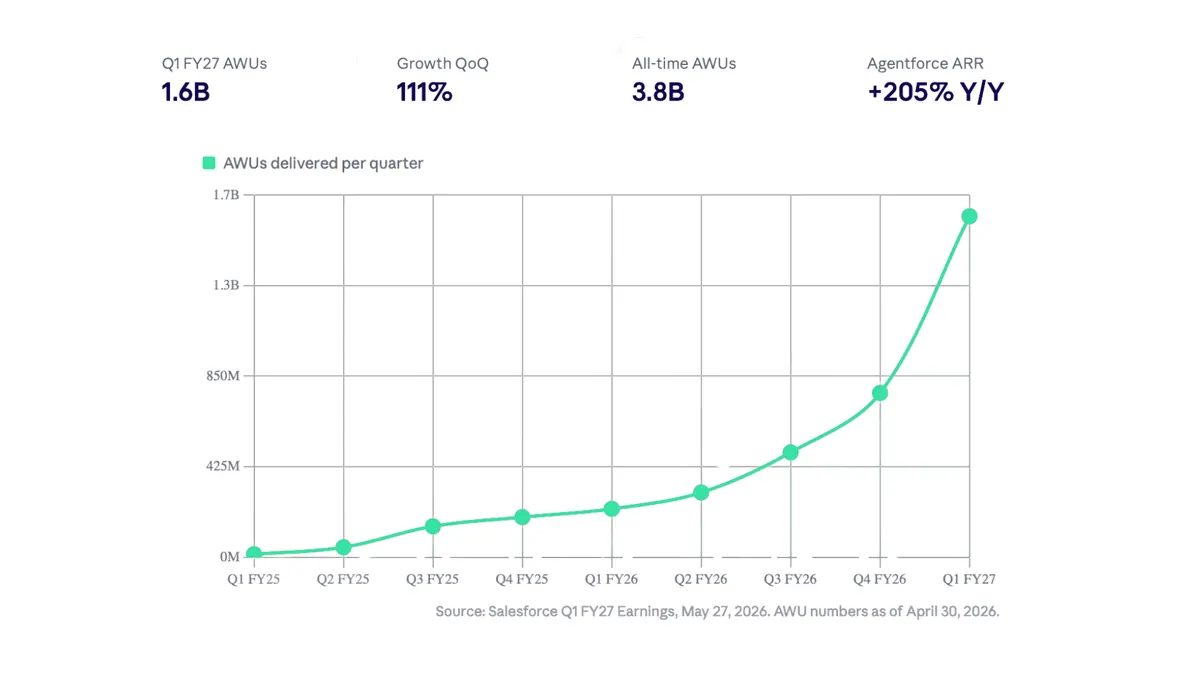
Salesforce posted $11.1 billion in Q1 FY27 revenue. Analysts nodded. Stocks moved. The usual.
But if you're a Salesforce developer (admin, architect, accidental DevOps person, whoever's actually keeping the lights on in your org) the number that should be living rent-free in your head isn't on the revenue slide. It's buried a few pages later, in a chart most investors probably skimmed past.
Let's talk about that chart. (You know the one that looks like a rocket taking off… 🚀)
1.6 Billion. In One Quarter!
That's the number of Agentic Work Units, or AWUs, Salesforce delivered in Q1 FY27 alone. (Want to view the whole report? Click here.)
An AWU, in Salesforce's own words, is "one discrete task accomplished by an AI agent — decisions made, records updated, workflows triggered, and more." In Q1 FY25, they delivered 14 million of them. By Q1 FY27, that number hit 1.6 billion. (With a B!) The chart shows that growth doesn't look like a trend line. It looks like a launch trajectory.
For context: Agentforce ARR grew 205% year-over-year and crossed $1.2 billion. Salesforce also reported 3.8 billion AWUs delivered all-time for live customer agents. More than half of which happened in a single quarter.
This isn't a feature gaining traction. This is a platform shift happening in real time.
Why This Matters More Than the Revenue Number
Revenue is a lagging indicator. It tells you what already happened. The AWU curve tells you what's coming.
Here's what that curve is actually saying to you as a developer: agents are no longer a Dreamforce demo or a pilot for enterprise customers with 50-person IT departments. They're in production. They're touching real orgs. They're making decisions, updating records, and triggering workflows in your customers' environments. Probably sooner than you think.
And here's the part that doesn't make the investor deck: agents don't exist in a vacuum. Every agent running in a Salesforce org is built on metadata. Flows, permission sets, custom objects, Apex classes. The same stuff you've been deploying (and occasionally breaking) for years. More agents means more metadata. More metadata means more complexity. More complexity means more things that can go wrong between your sandbox and production.
The AWU growth chart isn't just exciting. For Salesforce developers, it's a workload forecast.
The Revenue Reorganization Is the Other Signal You Shouldn't Miss
Here's the second thing buried in the deck: Salesforce didn't just report AI revenue, they restructured how they report revenue entirely.
They retired their old disaggregated structure. Agentforce Sales, Agentforce Service, Agentforce Marketing, all of it. Replaced with two buckets: Agentforce Apps and Data 360, Headless Platform & Other. The explicit reason given was to reflect how Agentforce is now "embedded in every app."
Read that again. Embedded in every app.
This isn't Salesforce adding an AI product to the catalog. This is Salesforce saying that AI is the organizing principle of their entire product architecture going forward. The revenue reporting structure follows the org chart. When a $46B company reorganizes both, that's a commitment, not a roadmap item.
For developers, the implication is straightforward: there will no longer be a clean line between "Salesforce work" and "AI work." If you're deploying metadata today, you'll be deploying agent configurations tomorrow. The tooling, the testing, the version control. All of it needs to be ready for that.
This Does Not Mean You Need To Panic
None of this means your job is disappearing. Quite the opposite.
The more agents Salesforce customers run, the more someone has to build, configure, test, and maintain them. Agents don't deploy themselves. They don't resolve their own merge conflicts. They don't know that your sandbox is three weeks out of sync with production. (That's on you. It's always on you.)
What it does mean is that the Salesforce developer who understands DevOps fundamentals will be significantly more valuable than the one who doesn't. Environment parity, metadata versioning, clean deployment pipelines. The complexity curve is going up whether your tooling is ready for it or not.
The Question Worth Asking Your Team This Week
Look at how your team currently manages deployments.
- How confident are you, honestly, that your sandboxes reflect what's in production?
- How long does it take to deploy a change you actually trust?
- If an agent misconfigures something in production tonight, how fast can you roll it back?
These aren't hypothetical questions anymore.
Salesforce just told 150,000+ customers that agents are the future of their platform, and the earnings numbers back it up. The gap between teams with solid DevOps practices and teams winging it with Change Sets is about to get a lot more visible.
The most important slide in the Q1 FY27 deck wasn't revenue. It was the one that told you how fast the platform is moving. The only question left is whether your team is moving with it.
Looking to get the right support in place before your team is left in the dust?
Blue Canvas is Salesforce DevOps built for the teams actually doing the work. Version control, metadata backups, sandbox compare, and deployment pipelines that don't require a PhD in Git. If your org is about to get a lot more complex, start your free trial before the agents arrive.